Unlock the Potential of 3D Printed Ceramics with Sinto Advanced Ceramics USA
Sinto Advanced Ceramics USA offers the ability to produce high quality 3D printed ceramics without the high barrier to entry often required to make ceramics, whether it is capital equipment in the form of kilns/printers or molds and tooling to produce parts from conventional means. In as little as 3 weeks and $1,000, SAC will deliver high quality ceramic parts to help realize your ceramic component needs.
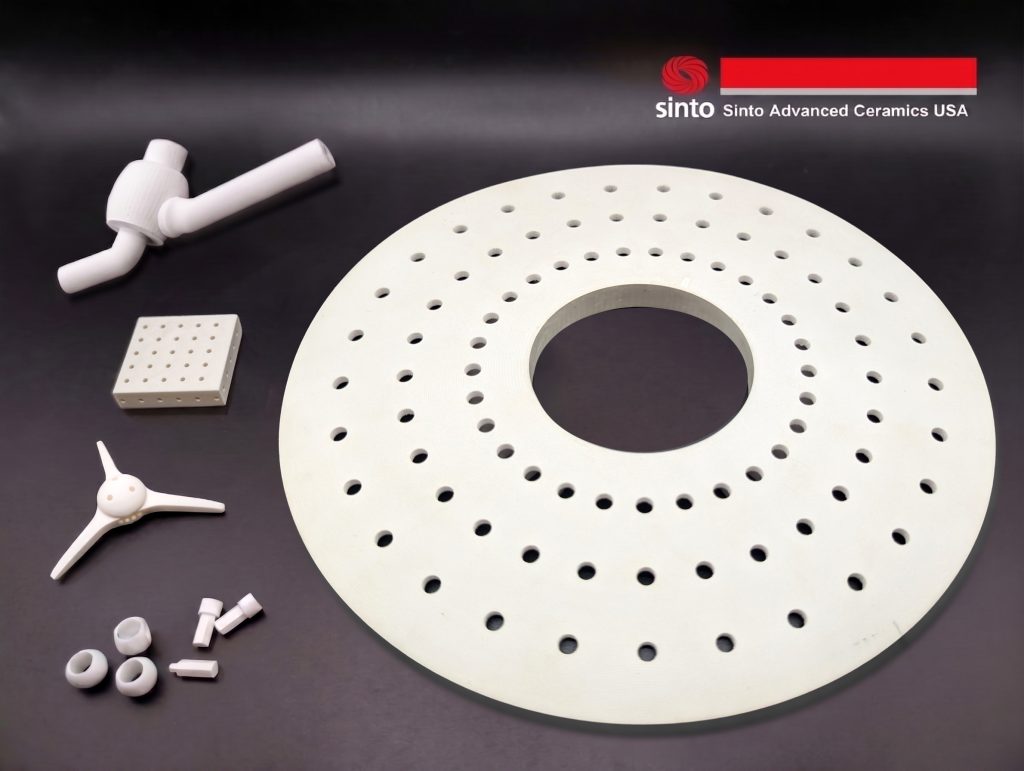
Background:
Sinto America, Inc.
Sinto America, Inc. is the North American group of companies of Sintokogio, Ltd., specializing in delivering equipment for foundry automation, whether in sand processing, mold making, gate grinding, or surface treatment through shot peening. In 2018, 3DCeram Sinto, Inc. expanded into the U.S. market, and SAI began selling its advanced ceramic 3D printing equipment. In 2025, this expanded from making the printers to making the ceramic parts. Now, along with branches in Japan and Germany, Sinto Advanced Ceramics is one of the world leaders in producing 3D printed ceramics parts.
Creating Ceramics:
Technical ceramics serve many needs throughout many industries. Properties like extreme temperature resistance, high wear resistance, near zero deflection, etc make them indispensable for users in extreme environments. Unfortunately, they are often extremely hard to process into usable shapes. Most often ceramics are made via uniaxial pressing or Ceramic Injection Molding (CIM). These technologies have the advantage of being scalable to 10,000 and more parts quickly, but also have extremely high prices for initial parts. A new CIM mold might cost $30,000 on the low end, and costs balloon over $1M quickly as part complexity increases. Worse yet, these molds have to be precision machined in hard to machine alloys and then tested, making the whole process from design to first articles take upwards of 8 months at minimum.
3D Printing offers a cost competitive solution to this issue, being able to produce parts almost immediately. These batches can be as small as a single part, and then can be scaled up to hundreds of parts relatively quickly.
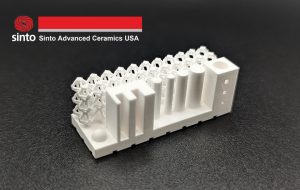
Outside of the world of ceramics 3D printing, this is a well understood point. Plastic printing constantly pressures injection molding in terms of quality and start up price. Ceramic 3D printing, however, has not seen as much use. This is because ceramics still require a lot of additional processing to control. Companies like 3D Ceram, Lithoz, Prodways, Tethon, and Formlabs have all developed printers and materials for printing ceramics, but the printers are typically extremely expensive (often exceeding $100k), as is the resin to feed them (often beyond $1,000 /L). In addition, the printing step is just the first step of the process, with parts needing to be cleaned, the organics removed, and then sintered to high temperatures.
This extra processing requires both expensive equipment and specialized expertise that most companies do not want to invest in. This is where Sinto Advanced Ceramics can help – rather than having to go through a long sales cycle and training cycle to obtain your parts, SAC will help to produce parts, going through the full process so that you can get your part with the least amount of fuss, time, and investment possible.
SAC Capabilities:
Certifications
As a contract manufacturer, Sinto Advanced Ceramics understands that you need your parts to come out at the highest quality possible and to comply with any regulations that may exist. As such, we are ISO 9001 certified and ITAR registered.
Material Capabilities
SAC specializes mainly in oxide ceramics:
Alumina:
Alumina
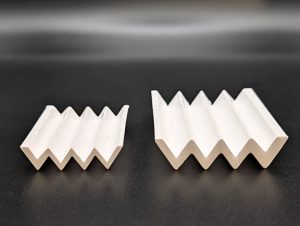
Alumina, or Aluminum Oxide, is the most common technical ceramic used in industry. It is generally the cheapest material and the most available. Capable of holding structure to almost 2000 °C it is fantastic for high temperature applications, and the extremely high electrical resistivity makes it perfect as an electrical insulator. The density can be tuned from 58% theoretical max density (TMD) to 99% TMD, which can be used to wick liquids or limit thermal conductivity.
3Y Zirconia:
3Y Zirconia
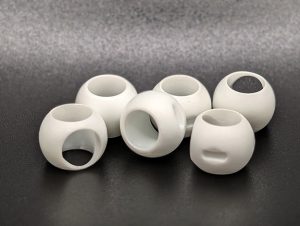
3Y Zirconia, often just referred to as zirconia, has 3% yttria added to stabilize the zirconia. Parts in this material are over twice as tough as Alumina parts, making them more suitable for industrial applications and situations that the parts are under strain. It is also often used in biomedical research, and is highly biocompatible.
Alumina Toughened Zirconia:
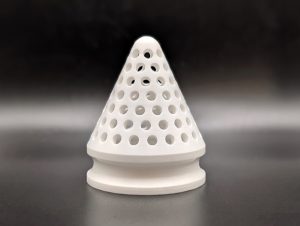
Alumina Toughened Zirconia 3d printed ceramics
ATZ is zirconia with some alumina added to stabilize and toughen the material. It is even stronger than 3Y, making it useful for parts demanding the toughest properties.
Investment Casting Silica:
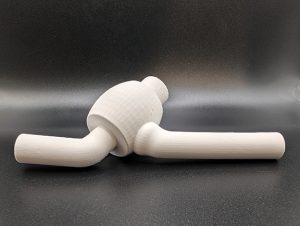
Investment Casting Silica
This material is developed specifically to work with the investment casting process, whether casting Aluminum, Steel, Inconel, or Stainless (it is not recommended for reactive alloys such as Mg or Ti). It is fired to leave some porosity and keep in permeable, allowing air to escape during the casting process, and is made of silica to make it as leachable as possible in internal cores.
Part Dimensions, Accuracy, and Repeatability
Printed parts can be made in a variety of size ranges, from less than a centimeter to nearly 30 cm. In general the maximum size of parts is about 280x280x80 mm. Features as small as 0.3 mm can be printed with a high resolution, even if the part itself is large, without changing the price of the overall part. In many cases added complexity to the part will actually decrease the cost of the part by reducing the total quantity of resin that is needed to produce the part.
Printed parts are extremely repeatable, with customer parts measuring a Cp of >1.67 on several different geometries, components, and bulk dimensions.
Even printed threads are possible, with threading as fine as M2 having been produced without major issue, although threading may require special attention depending on the exact tolerances and fitment desired.
Quality Control
Sinto Advanced Ceramics offers a comprehensive suite of QC controls, with a full metrology lab for ensuring part quality. For standard projects, SAC will still confirm process controls throughout, such as part density, thermal process controls, and printer quality checks. Further dimensional analysis is easily done with the aid of drawings. Generally as printed dimensions will be ±0.1 mm from the nominal dimensions for measurements <15 mm, and +/- 0.5 mm for measurements >15 mm, but tighter dimensional tolerances are possible (as low as +/- 0.05 mm).
Full QC reports are available, and can be made to be compliant with various different certification and COA requirements.
SAC can quote specific material or performance testing requirements, but some testing may require outside vendors to generate.
Sinto Advanced Ceramics, USA
If any of this is of interest to you, we encourage you to reach out to our engineers and sales representatives. They are experts in the field of ceramic 3D printing, and are happy to help you to realize your ceramic part needs.
Learn more about Sinto Advanced Ceramics USA online here.
Want to know about Sinto Advanced Ceramics capabilites?